Genogram Examples: 11 Completed Family Genograms
These are the 11 genogram practice cases, shown as completed genograms. None is drawn by hand: each is what the Auruda Genogram tool actually draws, with names and notes. The 5 historical cases show people who died more than 150 years ago, drawn only from relationships, years and events confirmed in public sources. The 6 anonymized cases take only the structure of situations common in practice (five couples in conflict seen in counseling, and one grandparent-headed household from social work case management) and do not refer to real people. All of them are notation exercises, not clinical cases.
The emotional relationship lines look the same as in the tool: a zigzag is hostile, two parallel lines are close, three are fused, a dotted line is distant, a line broken in the middle is a cutoff, and an arrowhead gives the direction. Select a genogram to open it full size in a new tab. Every symbol is in the genogram symbols chart.
What historical genogram examples are there?
Five family genograms of historical figures: Abraham Lincoln, Ludwig van Beethoven, Admiral Yi Sun-sin of Korea, and the Joseon kings Jeongjo and Yeonsangun. Each is drawn only from relationships, years and events confirmed in public historical sources.
Historical●●●AdvancedFamilyTrauma
Son of the crown prince
King Jeongjo, 22nd king of Joseon (1752-1800)
A king who grew up where his grandfather had put his father to death. Draw four generations of a royal family.
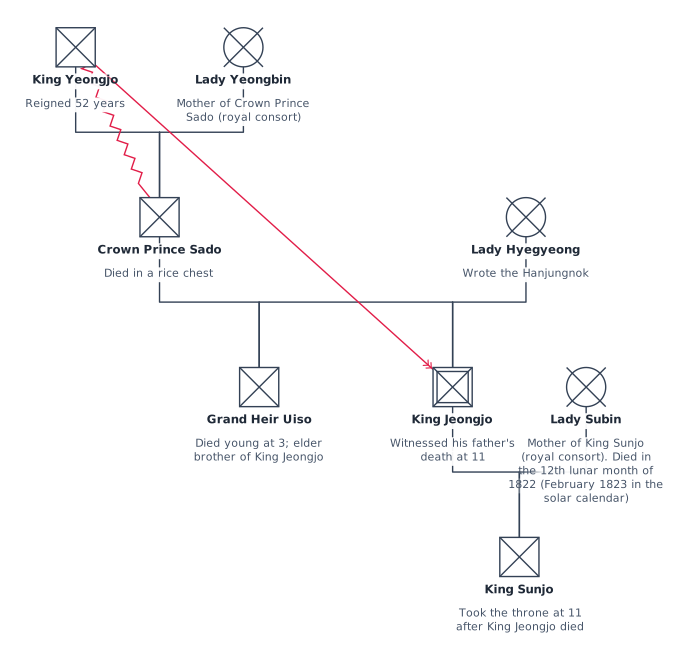
Reading the genogram Four generations run from top to bottom, from King Yeongjo to King Sunjo, and King Jeongjo, outlined with a double border, is the index person. Both red emotional relationship lines attach to King Yeongjo. The zigzag to Crown Prince Sado is hostile, and the line to King Jeongjo, ending in a double arrowhead, is a caregiver line, so at a glance you see a grandfather who turned against his son and then raised that son's son.
Draw this case yourself →Historical●●●AdvancedFamilyChildren and adolescentsTrauma
The son who learned the truth of his mother's death too late
Yeonsangun, 10th king of Joseon (1476-1506)
A king who learned the truth about his mother's death only after he came to the throne; she had been given poison when he was five. Draw two generations, including his stepmother and half-brother.
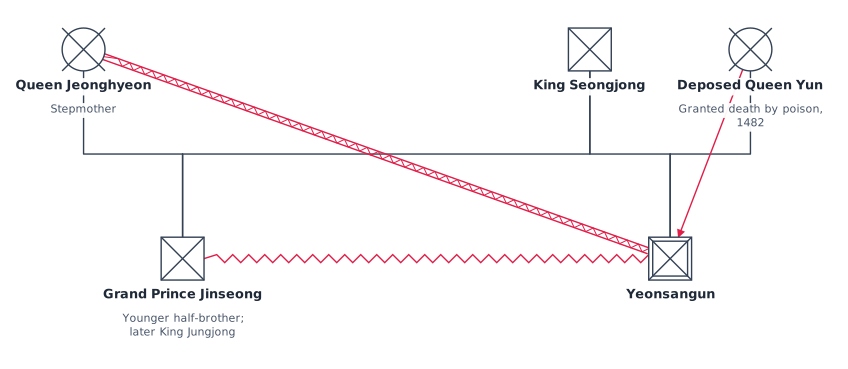
Reading the genogram A two-generation drawing of King Seongjong, his two queens, and their two sons, who are half-brothers; Yeonsangun, outlined with a double border, is the index person. The arrowed line from Deposed Queen Yun to Yeonsangun means focused on, and the zigzag between two parallel lines joining Queen Jeonghyeon and Yeonsangun is close-hostile. From Queen Jeonghyeon only this emotional relationship line reaches Yeonsangun, with no child line, so the drawing separates the mother who raised him from the mother who bore him.
Draw this case yourself →Historical●●●BasicFamily
Third of four brothers, and a son lost in battle
Yi Sun-sin of Joseon (1545-1598)
A family in which the youngest son and then Yi Sun-sin himself died in battle in successive years. Draw three generations, from his parents to his sons, in birth order.
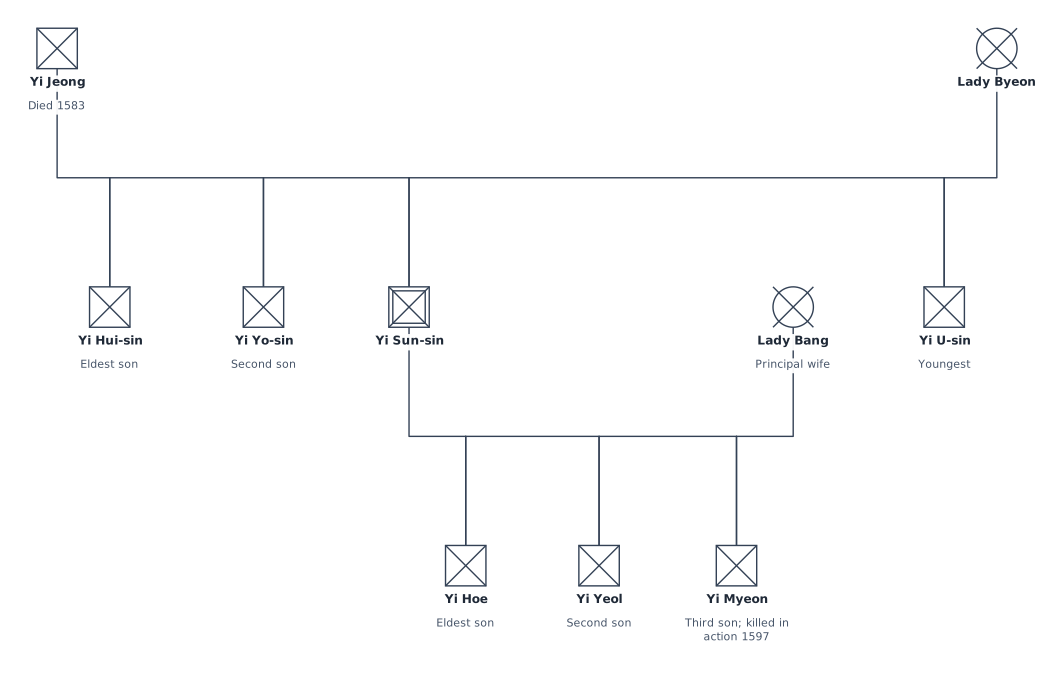
Reading the genogram Three generations in three rows: the parents, the four brothers, and the three sons; Yi Sun-sin, outlined with a double border, is the index person. Siblings are older the further left they stand, so Yi Sun-sin is the third of the four brothers and Yi Myeon the youngest of the three sons. There are no red emotional relationship lines at all. This is not an omission: no records tell us how the brothers felt about one another, so the space is left empty on purpose.
Draw this case yourself →Historical●●●IntermediateFamilyTraumaChildren and adolescents
Repeated loss — the deaths of three sons
Abraham Lincoln, 16th President of the United States (1809-1865)
He lost his mother at nine, and three of his four sons died young. Draw a remarried family that a stepmother joined.
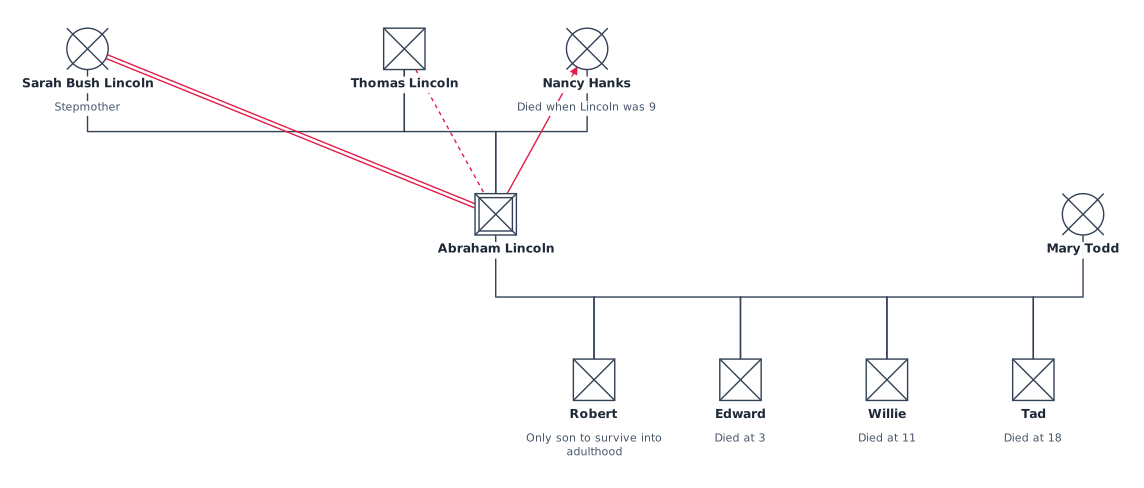
Reading the genogram Three generations run from Thomas Lincoln's two marriages to Abraham Lincoln's four sons, and Abraham Lincoln, outlined with a double border, is the index person. Of the emotional relationship lines that reach him, the one to his stepmother, Sarah Bush Lincoln, is two parallel lines (close), and the one to his birth father, Thomas Lincoln, is dotted (distant). The different shapes of the two lines show that he was closer to the stepmother who came through remarriage than to the father he was related to by blood.
Draw this case yourself →Historical●●●IntermediateFamilyAddictionChildren and adolescents
An alcohol-dependent father and custody of a nephew
Ludwig van Beethoven (1770-1827)
He grew up under a father dependent on alcohol and later fought for custody of his nephew. Draw three generations, from his parents to his nephew, and the relationships around the lawsuit.
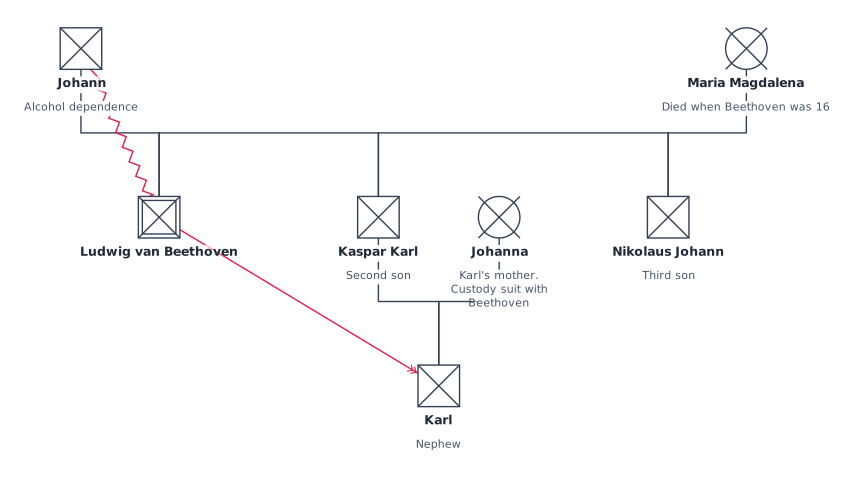
Reading the genogram Three brothers sit in one row under their parents, with their nephew Karl below, making three generations; Ludwig van Beethoven, outlined with a double border, is the index person. Karl's child line comes down from the middle couple, Beethoven's next-younger brother and his wife, while a separate caregiver line ending in a double arrowhead reaches Karl from Beethoven. The zigzag between his father, Johann, and Beethoven is hostile.
Draw this case yourself →
How do you draw a family from therapy or social work as a genogram?
Place the family members with marriage, divorce and child lines, then show the quality of the relationship between two people with a single emotional line, such as hostile, cutoff or caregiver.
Anonymized●●●BasicCouples
Control and silence — a couple five years married
Anonymized counseling case · 2 generations
A husband who drives his wife with rules, and a wife who has stopped talking. Draw the two of them and their young child.
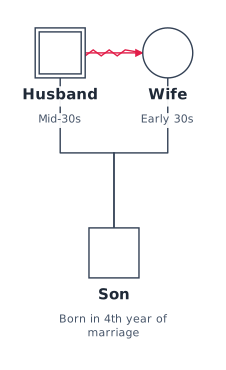
Reading the genogram A two-generation drawing of Husband, Wife, and Son; Husband, outlined with a double border, is the index person. Between the couple runs a single line, a thin zigzag laid over a straight arrow, from Husband toward Wife: he is focused on her negatively. Read the side the arrowhead points to as the one receiving the rules and the scolding.
Draw this case yourself →Anonymized●●●AdvancedOlder adults and caregivingCouplesFamily
More than a decade of caregiving — a marriage broken by care
Anonymized counseling case · 3 generations
A wife who cared for her mother-in-law alone for more than a decade, and a husband who took it for granted. Draw three generations, including the husband's parents.
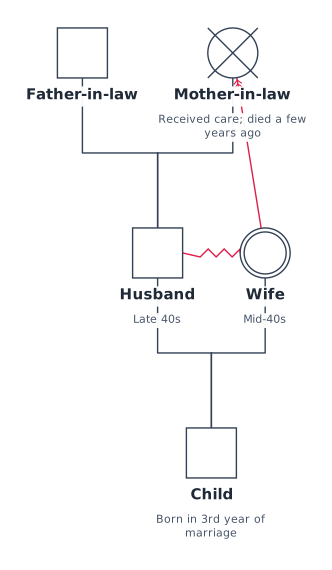
Reading the genogram Husband's parents, the couple, and their child form three generations; Wife, outlined with a double border, is the index person. The double arrowhead on the line joining Wife and Mother-in-law points toward Mother-in-law: this is a caregiver line, with the person who received care at the arrowhead. Wife is also joined to Husband by a zigzag (hostile), so the long years of care and the rift in the marriage converge on one person.
Draw this case yourself →Anonymized●●●IntermediateCouples
Harsh words and a closed mouth — pursuer and distancer
Anonymized counseling case · 2 generations
A wife who pours out harsh words and a husband who stops answering. Draw a pair in which the more one moves in, the more the other pulls back.
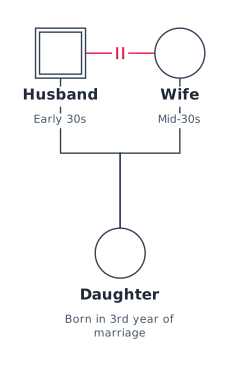
Reading the genogram A two-generation drawing of Husband, Wife, and Daughter; Husband, outlined with a double border, is the index person. The red line joining the couple is broken in the middle. Where distant, drawn as a dotted line, means the two have drifted apart, this cutoff means that the answers they used to exchange have stopped. There is only one emotional relationship line, between the couple, and it has no arrowhead, so it shows a single state between the two rather than who is directed at whom.
Draw this case yourself →Anonymized●●●IntermediateCouplesCrisis intervention
Suspicion and violence — a couple 21 years married
Anonymized counseling case · 2 generations
A wife who suspects her husband without evidence and a husband who responds with violence. Draw them and their now-adult child.
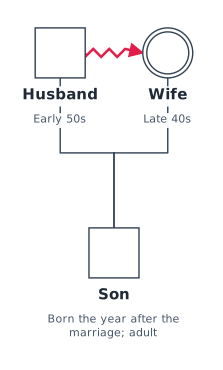
Reading the genogram A two-generation drawing of Husband, Wife, and their adult Son; Wife, outlined with a double border, is the index person. A heavy zigzag runs from Husband to Wife and ends directly in an arrowhead, with no straight line: this is physical abuse, and unlike the hostile zigzag, which has no arrowhead, it also shows which way the violence goes. Only the child lines from his parents reach Son's shape, and no red line does, so Son reads as a child who grew up beside the conflict rather than a party to it.
Draw this case yourself →Anonymized●●●AdvancedCouplesChildren and adolescentsCrisis intervention
A hidden past — control and violence on both sides
Anonymized counseling case · 2 generations
Draw a couple who clash with equal force after his hidden debts and previous marriage came to light.
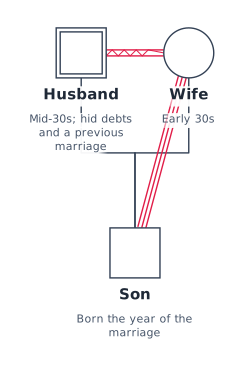
Reading the genogram A two-generation drawing of Husband, Wife, and Son; Husband, outlined with a double border, is the index person. The line joining the couple, a zigzag running between two parallel lines, is close-hostile: a relationship of fierce clashes in which the two still live together. The three parallel lines joining Wife and Son are fused, a sign that in the middle of the couple's fights the boundary between those two has blurred.
Draw this case yourself →Anonymized●●●AdvancedSocial workChildren and adolescentsFamily
A grandparent-headed family — a child raised by her grandmother
Anonymized social work case · 3 generations
An elementary school student raised by her paternal grandmother since her parents divorced. Draw three generations, starting from the grandparents, at an initial case management interview.
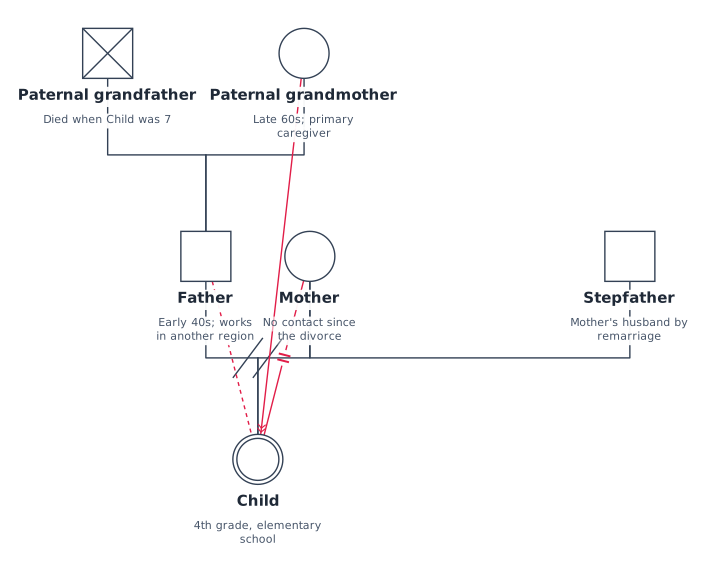
Reading the genogram The paternal grandparents, the parents with Stepfather, and Child form three generations; Child, outlined with a double border, is the index person. The two slashes on the marriage line joining Father and Mother mean divorce, and the line ending in a double arrowhead that runs from Paternal grandmother down to Child is a caregiver line. The point of this drawing is that the only line raising Child comes from Paternal grandmother.
Draw this case yourself →
Written by the Auruda editorial team · Last reviewed 2026-10-27 · The notation rules are explained in How to draw a genogram.