Genogram Practice: Draw a Genogram from a Case Study
Knowing the symbols is not the same as drawing a whole genogram. Each of the eleven case studies below gives a family structure step by step: the 5 historical cases use only the family structure confirmed in historical sources, and the 6 anonymized cases take only the structure of couples in conflict seen in counseling and of a grandparent-headed household met in social work case management. The historical cases span two to four generations; the anonymized ones show a couple and their children (two of them reach the grandparents). Follow the hints in order and you will have a finished genogram. They also work as a class exercise or assignment that does not use anyone's own family.
About these cases
There are two kinds. Historical cases concern people who died more than 150 years ago and use only relationships, years and events confirmed in public sources. Anonymized cases take only the structure of couples in conflict common in counseling and of families met in social work case management; they do not name or date anyone and do not refer to real people.
The “interpretation of the dynamics” in each case's last step is a hypothesis, not an answer, and it is not scored. These are notation exercises, not clinical cases.
What genogram case studies are there?
5 historical cases (Abraham Lincoln, Ludwig van Beethoven, Admiral Yi Sun-sin of Korea and the Joseon kings Jeongjo and Yeonsangun) and 6 anonymized cases rebuilt from counseling and social work practice: 11 in all.
Case 1Historical●●●AdvancedFamilyTrauma
Son of the crown prince
King Jeongjo, 22nd king of Joseon (1752-1800)
King Yeongjo (1694-1776), the twenty-first king of Joseon, reigned for 52 years. With his (hugung) Lady Yeongbin of the Yi clan (1696-1764), he had a son, Crown Prince Sado (1735-1762).
In 1744 Crown Prince Sado married Lady Hyegyeong (1735-1816). They had two sons. The elder, Grand Heir Uiso (1750-1752), died at the age of three (in traditional Korean age, which counts a newborn as one), and the younger was King Jeongjo (1752-1800).
Relations between King Yeongjo and Crown Prince Sado were bad for a long time and never recovered. In 1762 King Yeongjo locked Crown Prince Sado in a (dwiju), and the prince died eight days later. King Jeongjo was eleven at the time.
After his father's death, the one who took King Jeongjo in and taught him personally was his grandfather, King Yeongjo. King Jeongjo came to the throne in 1776 and worked to restore his father's honor.
With his Lady Subin of the Park clan (1770-1822), King Jeongjo had a son, King Sunjo (1790-1834). When King Jeongjo died in 1800, King Sunjo came to the throne at eleven. Lady Hyegyeong lived until 1816 and recorded these events in her memoir, the Hanjungnok.
Show the answer genogramafter you finish▾
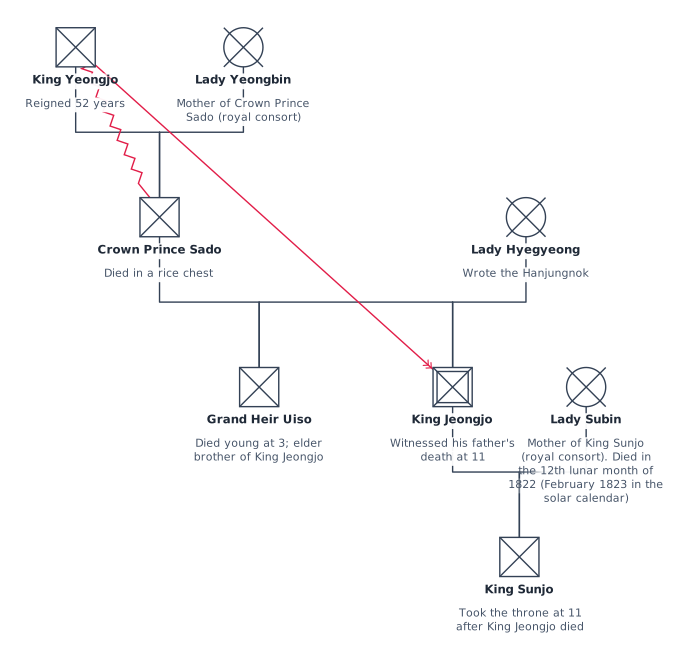
Names and notes are drawn in, so you can compare who goes where. The emotional lines look the same as in the tool: a zigzag is hostile, two parallel lines are close, three are fused, a dotted line is distant, a line broken in the middle is a cutoff, and an arrowhead gives the direction. When you check your genogram in the tool, it names the people and relationships you missed. Select the picture to open it full size in a new tab. Draw this caseStuck? Show hints5 steps▾
Step 1·Place the people first
Start by placing the eight people in the case: King Yeongjo, Lady Yeongbin, Crown Prince Sado, Lady Hyegyeong, Grand Heir Uiso, King Jeongjo, Lady Subin, and King Sunjo. The kings and their sons are male; the wives and royal consorts are female. King Jeongjo is the index person (client) of this case.
Step 2·Connect the couples
There are three couples: King Yeongjo and Lady Yeongbin, Crown Prince Sado and Lady Hyegyeong, and King Jeongjo and Lady Subin. A royal consort was an official spouse, taken into the royal household through formal procedures, so join all three couples with a marriage line (-----). In this case, draw only one spouse for King Yeongjo: Lady Yeongbin.
Step 3·Connect the children
Crown Prince Sado is the son of King Yeongjo and Lady Yeongbin; Grand Heir Uiso and King Jeongjo are the sons of Crown Prince Sado and Lady Hyegyeong; King Sunjo is the son of King Jeongjo and Lady Subin. Draw a child line down from each parent. Siblings run from the oldest on the left, so Grand Heir Uiso goes to the left of King Jeongjo.
Step 4·Emotional relationships
Join King Yeongjo and Crown Prince Sado with a hostile line (www), and King Yeongjo to King Jeongjo with a caregiver line (->>). The key fact in this genogram is that the grandfather who killed the boy's father raised the boy himself.
Step 5·Interpreting the dynamics (hypothesis)
One interpretation holds that King Jeongjo's position as 'a son who witnessed his father's death but could not intervene' was later reflected in his rule. This is, however, an inference from historical sources; King Jeongjo's own state of mind cannot be known. This step is not scored.
Case 2Historical●●●AdvancedFamilyChildren and adolescentsTrauma
The son who learned the truth of his mother's death too late
Yeonsangun, 10th king of Joseon (1476-1506)
King Seongjong (1457-1494) was the ninth king of Joseon. His first queen, Queen Gonghye, died childless. With his second queen, Deposed Queen Yun (1455-1482), he had a son, Yeonsangun (1476-1506).
In 1479 Yun was removed as queen, and three years later, in 1482, she was granted . Yeonsangun was two years old at the first and five at the second.
King Seongjong then took Queen Jeonghyeon (1462-1530) as his queen, and they had a son, Grand Prince Jinseong (1488-1544). Yeonsangun and Grand Prince Jinseong were half-brothers, with the same father and different mothers.
Yeonsangun was raised as the son of his stepmother, Queen Jeonghyeon. The circumstances of his birth mother's death were kept hidden; he first learned of them in 1495, three months after coming to the throne at the end of 1494, while reading the epitaph from the tomb of his father, King Seongjong (Annals of Yeonsangun). Yeonsangun posthumously restored his birth mother to the rank of queen, and in the Gapja Literati Purge of 1504 he executed the people involved in her deposition and death.
In 1506 his ministers removed Yeonsangun from the throne (the Jungjong coup). Queen Jeonghyeon approved it, and his half-brother, Grand Prince Jinseong, became the new king (King Jungjong). Yeonsangun died that same year in exile on Gyodong Island.
Show the answer genogramafter you finish▾
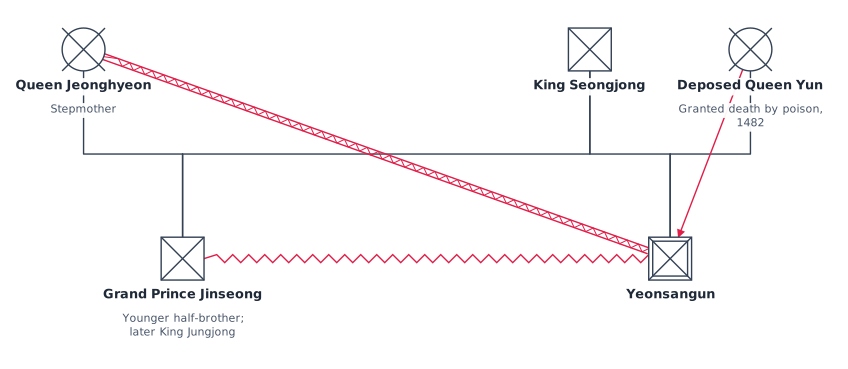
Names and notes are drawn in, so you can compare who goes where. The emotional lines look the same as in the tool: a zigzag is hostile, two parallel lines are close, three are fused, a dotted line is distant, a line broken in the middle is a cutoff, and an arrowhead gives the direction. When you check your genogram in the tool, it names the people and relationships you missed. Select the picture to open it full size in a new tab. Draw this caseStuck? Show hints5 steps▾
Step 1·Place the people first
Place the five people in the case: King Seongjong, Deposed Queen Yun, Queen Jeonghyeon, Yeonsangun, and Grand Prince Jinseong. The king and the princes are male; the queens are female. Yeonsangun is the index person (client).
Step 2·Connect the couples
King Seongjong is married to both Deposed Queen Yun and Queen Jeonghyeon. Both were queens, so join each with a marriage line (-----). Deposed Queen Yun was not an unofficial partner; she was a queen who was later deposed and granted death by poison. His first queen, Queen Gonghye, had no children and falls outside this case.
Step 3·Connect the children
Yeonsangun is the son of King Seongjong and Deposed Queen Yun; Grand Prince Jinseong is the son of King Seongjong and Queen Jeonghyeon. Queen Jeonghyeon raised Yeonsangun but was not his mother, so do not draw a child line from her to Yeonsangun; show that relationship with an emotional relationship line instead.
Step 4·Emotional relationships
Draw a focused-on line (--▶) from Deposed Queen Yun to Yeonsangun: his mother's death became the center of his later life. Join him to Queen Jeonghyeon with a close-hostile line (=w=): she was the stepmother who raised him as her son, yet approved the coup that deposed him. With Grand Prince Jinseong the line is hostile (www): he was the half-brother who took the throne through that coup.
Step 5·Interpreting the dynamics (hypothesis)
One possible interpretation is that discovering, years later, a death that had been hidden led to retaliation such as the Gapja Literati Purge of 1504. Yeonsangun's violence, however, came from power struggles and the conditions of his time as well, and family structure alone cannot explain it. This step is not scored.
Case 3Historical●●●BasicFamily
Third of four brothers, and a son lost in battle
Yi Sun-sin of Joseon (1545-1598)
Yi Sun-sin (1545-1598) was the third son of Yi Jeong (died 1583) and Lady Byeon of the Chogye Byeon clan (died 1597). He had two older brothers, Yi Hui-sin (1535-1592) and Yi Yo-sin (1542-1580), and one younger brother, Yi U-sin (1552-1630).
His brother Yi Yo-sin died in 1580. His father, Yi Jeong, died in 1583, when Yi Sun-sin was thirty-nine (in traditional Korean age, which counts a newborn as one). His eldest brother, Yi Hui-sin, died in 1592, the year the Imjin War (the Japanese invasion of Korea) broke out.
Yi Sun-sin married Lady Bang, and they had three sons: Yi Hoe (born 1567), Yi Yeol (born 1571), and Yi Myeon (1577-1597).
The youngest, Yi Myeon, was killed fighting Japanese forces in 1597. Yi Sun-sin's mother, Lady Byeon, died the same year. Yi Sun-sin himself was killed in action the following year, 1598, at Noryang.
Historical sources record nothing about the personal feelings between the brothers in this family. Do not draw an emotional relationship line without evidence; this case has no emotional relationship lines at all.
Show the answer genogramafter you finish▾
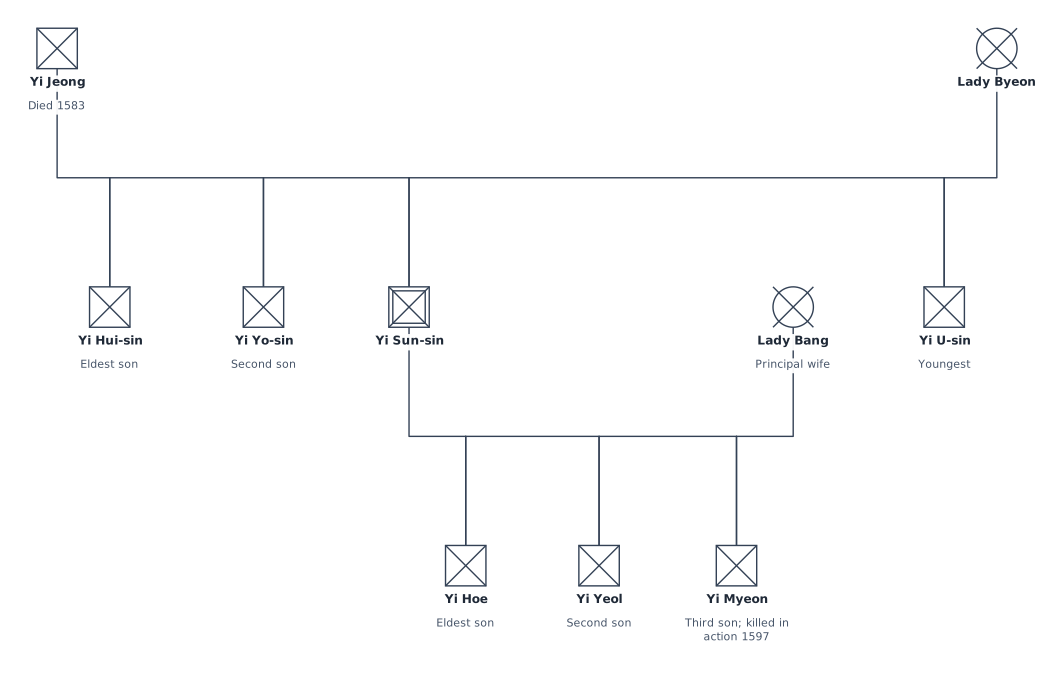
Names and notes are drawn in, so you can compare who goes where. The emotional lines look the same as in the tool: a zigzag is hostile, two parallel lines are close, three are fused, a dotted line is distant, a line broken in the middle is a cutoff, and an arrowhead gives the direction. When you check your genogram in the tool, it names the people and relationships you missed. Select the picture to open it full size in a new tab. Draw this caseStuck? Show hints5 steps▾
Step 1·Place the people first
Place the ten people in the case: Yi Jeong, Lady Byeon, the four brothers (Yi Hui-sin, Yi Yo-sin, Yi Sun-sin, Yi U-sin), Lady Bang, and the three sons (Yi Hoe, Yi Yeol, Yi Myeon). Yi Sun-sin is the index person (client).
Step 2·Connect the couples
There are two married couples: Yi Jeong and Lady Byeon, and Yi Sun-sin and Lady Bang. Join both with a marriage line (-----).
Step 3·Birth order
Place siblings from the left in order of birth: Yi Hui-sin, Yi Yo-sin, Yi Sun-sin, Yi U-sin, and in the next generation Yi Hoe, Yi Yeol, Yi Myeon. If the order is wrong, no one can read who is older.
Step 4·No emotional relationships
Draw no emotional relationship lines in this case, because the sources record no individual feelings. Not drawing what is not there is also part of the notation rules.
Step 5·Interpreting the dynamics (hypothesis)
Death in battle appears across two generations: Yi Sun-sin himself and his son Yi Myeon. This, however, reflects the built-in risk of a military career, and it is hard to establish a cause in family dynamics. This step is not scored.
Case 4Historical●●●IntermediateFamilyTraumaChildren and adolescents
Repeated loss — the deaths of three sons
Abraham Lincoln, 16th President of the United States (1809-1865)
Abraham Lincoln (1809-1865) was the son of Thomas Lincoln (1778-1851) and Nancy Hanks (1784-1818).
His mother, Nancy Hanks, died in 1818, when Lincoln was nine. The following year his father, Thomas Lincoln, remarried, to Sarah Bush Lincoln (1788-1869). His stepmother, Sarah Bush Lincoln, treated Lincoln like her own son, and the two stayed close all their lives. Lincoln and his father, Thomas Lincoln, by contrast, were distant: Lincoln did not even attend his father's funeral.
Lincoln married Mary Todd (1818-1882), and they had four sons: Robert (1843-1926), Edward (1846-1850), Willie (1850-1862), and Tad (1853-1871).
Three of the four sons died young. Edward died at three, Willie at eleven, and Tad at eighteen. Robert was the only son who lived into adulthood.
Lincoln is recorded as having suffered deep depression throughout his life. Nancy Hanks, the mother he lost at nine, remained the mother he kept in mind and recalled until his death.
Show the answer genogramafter you finish▾
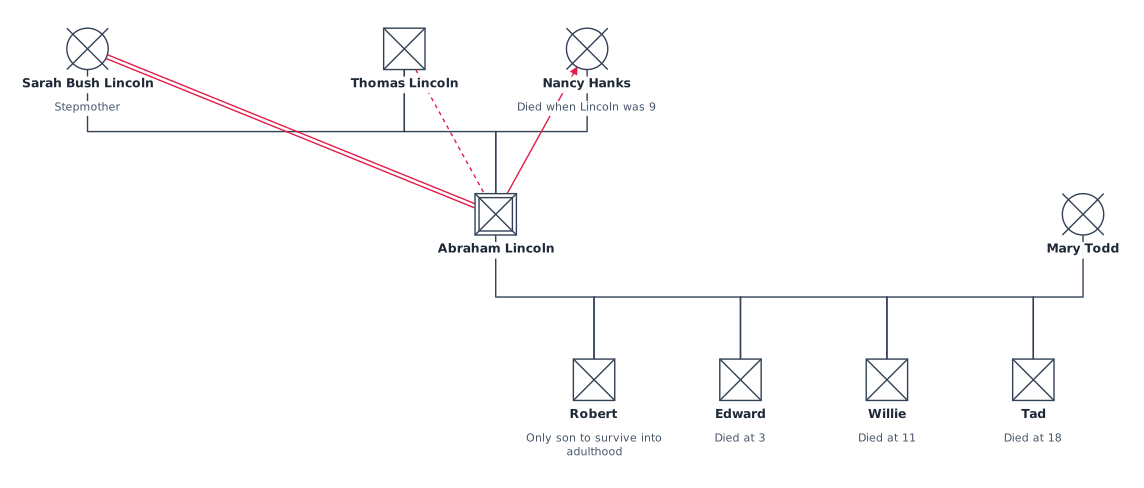
Names and notes are drawn in, so you can compare who goes where. The emotional lines look the same as in the tool: a zigzag is hostile, two parallel lines are close, three are fused, a dotted line is distant, a line broken in the middle is a cutoff, and an arrowhead gives the direction. When you check your genogram in the tool, it names the people and relationships you missed. Select the picture to open it full size in a new tab. Draw this caseStuck? Show hints5 steps▾
Step 1·Place the people first
Place the nine people in the case: Thomas Lincoln, Nancy Hanks, Sarah Bush Lincoln, Abraham Lincoln, Mary Todd, and the four sons (Robert, Edward, Willie, Tad). Abraham Lincoln is the index person (client).
Step 2·Connect the couples
Thomas Lincoln married Nancy Hanks, and after Nancy died he remarried, to Sarah Bush Lincoln. Both relationships take a marriage line (-----). Join Abraham Lincoln and Mary Todd with a marriage line too.
Step 3·Connect the children
Abraham Lincoln is the son of Thomas Lincoln and Nancy Hanks. Do not draw a child line from his stepmother, Sarah Bush Lincoln. The four sons are the children of Abraham Lincoln and Mary Todd; place them from the left in birth order: Robert, Edward, Willie, Tad.
Step 4·Emotional relationships
Draw a focused-on line (--▶) from Abraham Lincoln to Nancy Hanks, a close line (===) with Sarah Bush Lincoln, and a distant line (...) with Thomas Lincoln. The key to this genogram is the contrast: close to his stepmother, distant from his birth father.
Step 5·Interpreting the dynamics (hypothesis)
The loss at nine overlaps with the repeated losses of his adult years. Lincoln's depression is documented in records of his time, but tying it directly to family loss is interpretation. This step is not scored.
Case 5Historical●●●IntermediateFamilyAddictionChildren and adolescents
An alcohol-dependent father and custody of a nephew
Ludwig van Beethoven (1770-1827)
Ludwig van Beethoven (1770-1827) was the eldest son of Johann (1740-1792) and Maria Magdalena (1746-1787). He had two younger brothers, Kaspar Karl (1774-1815) and Nikolaus Johann (1776-1858).
His father, Johann, was dependent on alcohol and forced his young son to perform. The two were on bad terms. His mother, Maria Magdalena, died in 1787, when Beethoven was sixteen, and from then on Beethoven effectively took charge of the household.
From about the age of twenty-six Beethoven began to lose his hearing, and by forty-five he could hardly hear at all.
His brother Kaspar Karl married Johanna (1786-1869), and they had a son, Karl (1806-1858). When Kaspar Karl died in 1815, Beethoven sued Karl's mother, Johanna, for custody, and the dispute went on for several years. Beethoven wanted to keep his nephew Karl with him as if he were his own son.
Show the answer genogramafter you finish▾
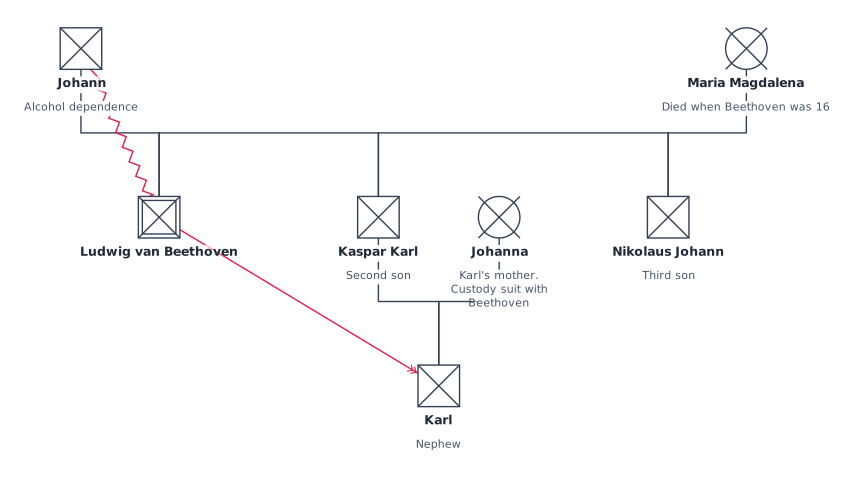
Names and notes are drawn in, so you can compare who goes where. The emotional lines look the same as in the tool: a zigzag is hostile, two parallel lines are close, three are fused, a dotted line is distant, a line broken in the middle is a cutoff, and an arrowhead gives the direction. When you check your genogram in the tool, it names the people and relationships you missed. Select the picture to open it full size in a new tab. Draw this caseStuck? Show hints5 steps▾
Step 1·Place the people first
Place the seven people in the case: Johann, Maria Magdalena, the three brothers (Ludwig van Beethoven, Kaspar Karl, Nikolaus Johann), Johanna, and Karl. Ludwig van Beethoven is the index person (client).
Step 2·Connect the couples
There are two married couples: Johann and Maria Magdalena, and Kaspar Karl and Johanna. Join both with a marriage line (-----).
Step 3·Connect the children
The three brothers are the sons of Johann and Maria Magdalena; place them from the left in birth order: Ludwig van Beethoven, Kaspar Karl, Nikolaus Johann. Karl is the son of Kaspar Karl and Johanna: Beethoven's nephew, not his child.
Step 4·Emotional relationships
Draw a caregiver line (->>) from Ludwig van Beethoven to his nephew Karl: someone who took on raising a child without being the parent. Join him to his father, Johann, with a hostile line (www). The lawsuit with Johanna was a fight over the nephew, so instead of joining the two of them directly, read it as the caregiver relationship toward Karl; a line to a brother's spouse would disturb the generation layout.
Step 5·Interpreting the dynamics (hypothesis)
One interpretation reads this as an attempt to give his nephew the protection he himself never received. Beethoven's motives, however, cannot be established from the sources. This step is not scored.
Case 6Anonymized●●●BasicCouples
Control and silence — a couple five years married
Anonymized counseling case · 2 generations
Husband, in his mid-thirties, and Wife, in her early thirties, are in the fifth year of their marriage. Their only child, Son, was born in the fourth year of the marriage.
Husband makes living diligently his standard for life. He demanded the same standard of Wife, who has struggled with depression and lethargy since giving birth. He set every detail for her, from when she got up and how much she ate to when she went out, and scolded her when she did not keep to it.
Wife could not argue back. At first she tried to explain, but as every conversation ended in a lecture she gradually fell silent. Now, when Husband speaks to her, she answers briefly and leaves the room.
The two came to counseling together. Husband said he came because he wanted Wife to get better; Wife said she did not know what she had done wrong.
Show the answer genogramafter you finish▾
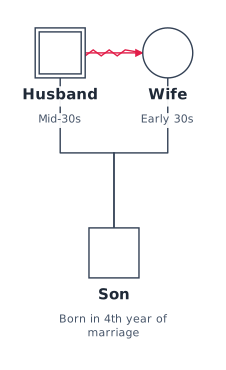
Names and notes are drawn in, so you can compare who goes where. The emotional lines look the same as in the tool: a zigzag is hostile, two parallel lines are close, three are fused, a dotted line is distant, a line broken in the middle is a cutoff, and an arrowhead gives the direction. When you check your genogram in the tool, it names the people and relationships you missed. Select the picture to open it full size in a new tab. Draw this caseStuck? Show hints4 steps▾
Step 1·Place the people first
Place the three people: Husband, Wife, and Son. Husband is the index person in this case. This is an anonymized case with no names, so write each person's role where the name would go.
Step 2·The couple and their child
Join Husband and Wife with a marriage line (-----). Son is their child, so draw a child line down from each parent.
Step 3·Emotional relationship
Draw a 'focused on (negatively)' line (w-▶) from Husband to Wife. This symbol marks a relationship in which one person targets and pressures the other, and the arrow shows the direction. Draw only one emotional relationship line per pair: rather than drawing what each feels toward the other separately, mark the nature of the relationship with a single symbol.
Step 4·Interpreting the dynamics (hypothesis)
Husband may be handling his own anxiety by managing his partner, and Wife, lacking the strength to push back, may be holding out by withdrawing. The two partners' family backgrounds, however, cannot be known from this material alone. This step is not scored.
Case 7Anonymized●●●AdvancedOlder adults and caregivingCouplesFamily
More than a decade of caregiving — a marriage broken by care
Anonymized counseling case · 3 generations
Wife, in her mid-forties, and Husband, in his late forties, are in the seventeenth year of their marriage. They have one child. Child was born in the third year of the marriage. Husband's parents are Father-in-law and Mother-in-law.
From just after the wedding, Wife cared for Mother-in-law, who could barely move on her own. For more than a decade she bathed her, fed her, and dealt with her toileting, all by herself. Mother-in-law died a few years ago; Father-in-law is still alive but took no part in her care.
Husband regarded those years as simply Wife's duty. He did nothing for the housework or the caregiving, and when Wife said it was hard, he got irritated and walked away.
After the caregiving ended, Wife was left with panic symptoms and compulsive cleanliness. She cannot stand Husband lying in bed without washing, and they have slept in separate rooms for a long time. Wife says that whenever she sees Husband, the past years come back to her.
Show the answer genogramafter you finish▾
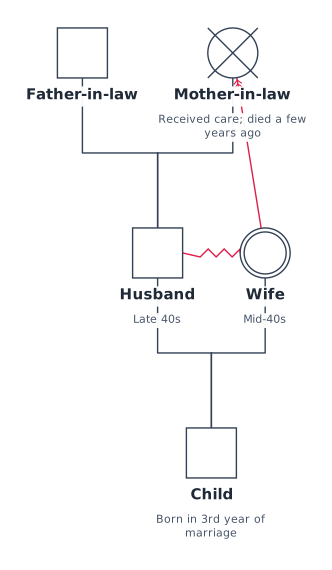
Names and notes are drawn in, so you can compare who goes where. The emotional lines look the same as in the tool: a zigzag is hostile, two parallel lines are close, three are fused, a dotted line is distant, a line broken in the middle is a cutoff, and an arrowhead gives the direction. When you check your genogram in the tool, it names the people and relationships you missed. Select the picture to open it full size in a new tab. Draw this caseStuck? Show hints5 steps▾
Step 1·Place the people first
Place the five people: Father-in-law, Mother-in-law, Husband, Wife, and Child. Wife is the index person. Mother-in-law has died, so turn on the deceased marker (an X is drawn on the shape).
Step 2·Connect the generations
Join Father-in-law and Mother-in-law with a marriage line (-----), and draw child lines from both of them down to Husband. Even though the case says little about Father-in-law, a person has two parents, so draw both; drawing only one would leave Husband without a father. Join Husband and Wife with a marriage line as well; Child is their child.
Step 3·The caregiving relationship
Draw a caregiver line (->>) from Wife to Mother-in-law: a daughter-in-law caring for her mother-in-law. This runs opposite to a parent caring for a child, so take care not to reverse the direction.
Step 4·The couple's emotional relationship
Draw a hostile line (www) between Wife and Husband. Resentment and avoidance pass between them, but draw only one emotional relationship line per pair: rather than drawing each person's feelings separately, mark the nature of the relationship with one symbol.
Step 5·Interpreting the dynamics (hypothesis)
The long years of care may have erased the boundaries of Wife's body and mind, and her compulsive cleanliness can be read as an attempt to reclaim those boundaries. It is hard, however, to pin the symptoms on a single cause. This step is not scored.
Case 8Anonymized●●●IntermediateCouples
Harsh words and a closed mouth — pursuer and distancer
Anonymized counseling case · 2 generations
Husband, in his early thirties, and Wife, in her mid-thirties, are in the fourth year of their marriage. Their only child, Daughter, was born in the third year of the marriage.
Over even minor disagreements, Wife cannot hold back harsh words. Her voice rises and swearing creeps in. She says she regrets it herself afterward.
Hurt by her words, Husband decided to stop answering. Even when asked a question, he stays silent and goes into another room. That silence makes Wife angry again, and when Wife raises her voice, Husband shuts down even further.
Both of them recognize this cycle. Yet they say they do not know where to break it.
Show the answer genogramafter you finish▾
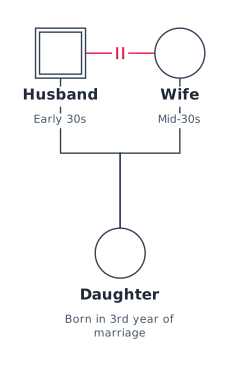
Names and notes are drawn in, so you can compare who goes where. The emotional lines look the same as in the tool: a zigzag is hostile, two parallel lines are close, three are fused, a dotted line is distant, a line broken in the middle is a cutoff, and an arrowhead gives the direction. When you check your genogram in the tool, it names the people and relationships you missed. Select the picture to open it full size in a new tab. Draw this caseStuck? Show hints4 steps▾
Step 1·Place the people first
Place the three people: Husband, Wife, and Daughter. Husband is the index person.
Step 2·The couple and their child
Join Husband and Wife with a marriage line (-----); Daughter is their child, so draw a child line down from each parent.
Step 3·Emotional relationship
Draw a cutoff line (-/-) between the two. No words passing between them is the nature of this relationship. It is easy to confuse with distant (...): distant means the two have grown apart, while cutoff means that what used to pass between them has stopped. Here Husband has stopped answering, so it is a cutoff.
Step 4·Interpreting the dynamics (hypothesis)
A pair in which the more one moves in, the more the other pulls back is sometimes called pursuer-distancer. The pursuer gets no response and so speaks louder; the distancer pulls further away from the louder voice. Working out who started it is usually not helpful. This step is not scored.
Case 9Anonymized●●●IntermediateCouplesCrisis intervention
Suspicion and violence — a couple 21 years married
Anonymized counseling case · 2 generations
Husband, in his early fifties, and Wife, in her late forties, are in the twenty-first year of their marriage. Son, born the year after they married, is now an adult.
For a long time Wife has believed that Husband is seeing someone outside the marriage. Nothing has been confirmed, but a late return home or a short phone call is enough to start an interrogation. Checking his phone has become routine.
Each time, Husband protests that he is being wronged and shouts, and on several occasions he has hit her. Even while being hit, Wife did not give up her suspicion, and the more Husband was suspected, the angrier he became.
Son grew up watching these scenes from early childhood. Now he rarely comes home.
Show the answer genogramafter you finish▾
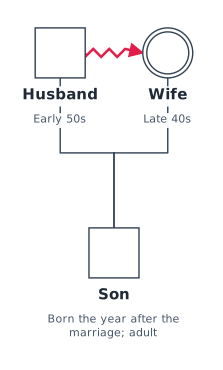
Names and notes are drawn in, so you can compare who goes where. The emotional lines look the same as in the tool: a zigzag is hostile, two parallel lines are close, three are fused, a dotted line is distant, a line broken in the middle is a cutoff, and an arrowhead gives the direction. When you check your genogram in the tool, it names the people and relationships you missed. Select the picture to open it full size in a new tab. Draw this caseStuck? Show hints5 steps▾
Step 1·Place the people first
Place the three people: Husband, Wife, and Son. Wife is the index person. Son is an adult but is still a member of this family.
Step 2·The couple and their child
Join Husband and Wife with a marriage line (-----); Son is their child.
Step 3·Emotional relationship
Draw a physical abuse line (ww▶) from Husband to Wife. In a relationship with violence, that fact must be read before anything else, so use the abuse symbol, not hostile (www). There is one emotional relationship line per pair, and the arrow points in the direction of the harm.
Step 4·The child's place
Draw no emotional relationship line between Son and his parents. That he avoids coming home does not tell us with which parent he has what kind of relationship; the rule is not to draw a line without evidence.
Step 5·Interpreting the dynamics (hypothesis)
The suspicion may be fear of abandonment showing up as holding on to the partner, and the violence may be an immature response to pressure he could not handle. An explanation must not become a justification, however: no dynamic justifies violence, and securing safety is the first task of counseling. This step is not scored.
Case 10Anonymized●●●AdvancedCouplesChildren and adolescentsCrisis intervention
A hidden past — control and violence on both sides
Anonymized counseling case · 2 generations
Husband, in his mid-thirties, and Wife, in her early thirties, are in the sixth year of their marriage. Son was born the same year they married.
After the wedding it came out that Husband had unpaid debts and a child from a previous marriage. From then on Wife could not trust Husband.
Wife went as far as tracking Husband's whereabouts, controlling the money, and not letting him use the bathroom at home. Husband met that control with verbal abuse and physical fights. The police have been called to their fights several times.
Even so, Wife says she will not end the marriage. Husband does not leave home either. Son is growing up between them, and Wife says that, whatever happens, she will keep the child with her.
Show the answer genogramafter you finish▾
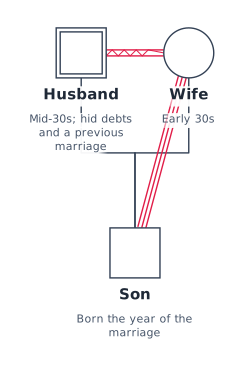
Names and notes are drawn in, so you can compare who goes where. The emotional lines look the same as in the tool: a zigzag is hostile, two parallel lines are close, three are fused, a dotted line is distant, a line broken in the middle is a cutoff, and an arrowhead gives the direction. When you check your genogram in the tool, it names the people and relationships you missed. Select the picture to open it full size in a new tab. Draw this caseStuck? Show hints5 steps▾
Step 1·Place the people first
Place the three people: Husband, Wife, and Son. Husband is the index person. The case gives no information about the child from his previous marriage, so do not draw that child.
Step 2·The couple and their child
Join Husband and Wife with a marriage line (-----); Son is their child.
Step 3·Close-hostile on both sides
Draw a close-hostile line (=w=) between Husband and Wife. One symbol captures a state in which the two attack each other yet do not end the relationship: a zigzag (hostile) drawn over two parallel lines (close). The symbol has no direction, so one line is enough.
Step 4·Mother and son
Draw a fused line (≡≡≡) from Wife to Son: in the middle of the marital conflict she is holding on to the child as her ally. The symbol means not closeness but a state in which the boundary has disappeared.
Step 5·Interpreting the dynamics (hypothesis)
One can see a vicious circle that binds the two together: the sense of betrayal after the hidden facts came out turned into control, and resistance to that control turned into violence. In a relationship with violence, however, safety comes before reading the dynamics. This step is not scored.
Case 11Anonymized●●●AdvancedSocial workChildren and adolescentsFamily
A grandparent-headed family — a child raised by her grandmother
Anonymized social work case · 3 generations
The case management client is Child, a girl in the fourth grade of elementary school. On a referral from the community children's center Child attends, a case manager visited the home for an initial interview. Paternal grandmother, who lives with Child, told the family's story.
Father, the only son of Paternal grandfather and Paternal grandmother, is now in his early forties. Father and Mother divorced when Child was five. Father took custody of Child, but when work kept him in another region he left her at his parents' home, and from then on her paternal grandparents raised her. Paternal grandfather died of an illness when Child was seven, and since then Paternal grandmother has raised Child alone.
Father still works in another region. He drops by only on major holidays or Child's birthday, and he rarely calls. The last news of Mother was word that she had remarried, to Stepfather, two years after the divorce; since then there has been no contact with Mother. Neither Paternal grandmother nor Child knows where Mother lives.
Paternal grandmother, in her late sixties, handles Child's trips to and from school, her meals, and her doctor's visits on her own. She said her knees are bad and walking for long is hard. What worried Paternal grandmother most was that if she fell ill, there would be no one to look after Child.
Show the answer genogramafter you finish▾
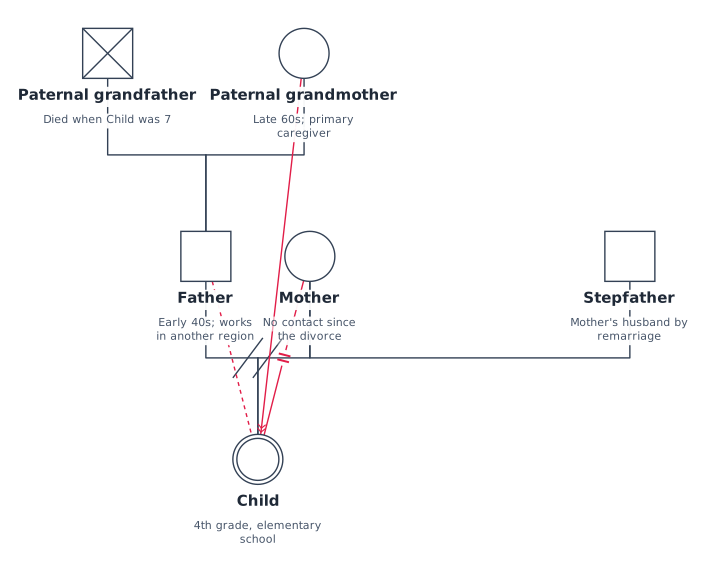
Names and notes are drawn in, so you can compare who goes where. The emotional lines look the same as in the tool: a zigzag is hostile, two parallel lines are close, three are fused, a dotted line is distant, a line broken in the middle is a cutoff, and an arrowhead gives the direction. When you check your genogram in the tool, it names the people and relationships you missed. Select the picture to open it full size in a new tab. Draw this caseStuck? Show hints5 steps▾
Step 1·Place the people first
Place the six people: Paternal grandfather, Paternal grandmother, Father, Mother, Stepfather, and Child. The index person is Child, the case management client. Paternal grandfather has died, so turn on the deceased marker (an X is drawn on the shape).
Step 2·Connect the generations
Join Paternal grandfather and Paternal grandmother with a marriage line (-----), and draw child lines from both of them down to Father. 'Paternal' grandparents are the father's parents, so do not connect them to Mother. Father is an only son, so draw no siblings.
Step 3·Divorce and remarriage
Join Father and Mother with a divorce line (-//--): two slashes are drawn across the marriage line. Child is their child, so draw a child line down from each parent. Join Mother and Stepfather with a marriage line (-----). Stepfather is not Child's parent, so draw no child line from him.
Step 4·Emotional relationships
Draw a caregiver line (->>) from Paternal grandmother to Child: someone who has taken on raising a child without being the parent. Draw a distant line (...) between Father and Child, and a cutoff line (-/-) between Mother and Child. There is still some contact with Father, however rare, so that is distant; contact with Mother has stopped altogether, so that is a cutoff.
Step 5·Interpreting the dynamics (hypothesis)
All the care rests on Paternal grandmother alone: her worry that no one would look after Child if she fell ill is plain to see in the genogram. In case management, this drawing can be the basis for looking for both informal support, such as relatives and neighbors, and formal services. How Child is taking her parents' absence cannot be known from this material, so it should be checked by talking with Child separately. This step is not scored.
How is the genogram practice scored?
Your finished genogram is compared with the answer by structure and scored out of 100: people 35, relationships 50 and gender 15. When you open a case in the tool, a scoring button appears with it.
- People, 35 points — did you include everyone in the case, and no one extra?
- Relationships, 50 points — who is joined to whom, with which symbol. A marriage line counts the same whichever side each partner is on; child lines and arrow symbols are checked for direction too.
- Gender, 15 points — did you pick the right shape (a square for a male, a circle for a female)?
Positions and layout are not scored: automatic layout produces them, so they are not something you can get right or wrong. The interpretation of the dynamics is not scored either, because it has no single answer.
Written by the Auruda editorial team · Last reviewed 2026-10-27 · Facts in the cases follow public sources, and the interpretation steps are marked as hypotheses. See also How to draw a genogram and the genogram examples with every answer drawn.